
Table of Contents
For years, many business owners viewed a website as a digital luxury, a fancy online business card that was nice to have, but not strictly necessary. Even today, some entrepreneurs ask, “Why should I spend money on a custom website when I can just create a free Facebook or Instagram page?”
If you are a business owner trying to justify the expense of building or upgrading your digital real estate, you need to look past the surface code and colors. You need to look at the Return on Investment (ROI).
By mid-2026, social media algorithms are more crowded and unpredictable than ever. Relying entirely on a third-party platform means you are building your house on rented land. A custom website, however, is an asset you own completely. But does it actually make you money?
Let’s skip the tech jargon, break down the real math behind website ROI, and look at how a properly optimized website functions as your hardest-working, 24/7 sales employee.
The Basic Math of Website ROI
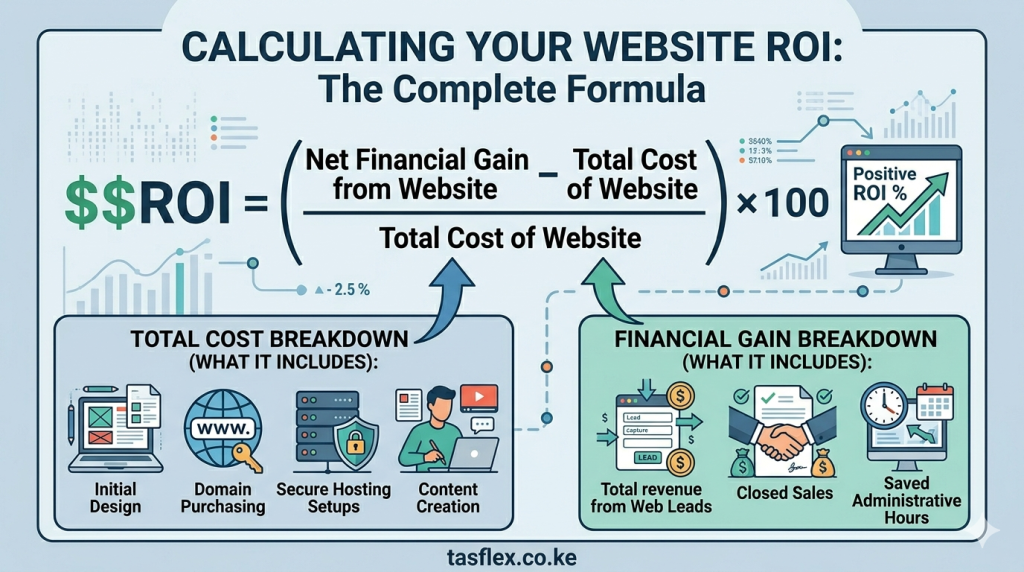
Before looking at the hidden benefits, let’s look at the literal financial formula for Return on Investment. To calculate the true ROI of your website, you use this standard equation:
$$ROI = \left( \frac{\text{Net Financial Gain from Website} – \text{Total Cost of Website}}{\text{Total Cost of Website}} \right) \times 100$$
The total cost includes your initial design, domain purchasing, secure hosting setups, and content creation. The financial gain is the total revenue brought in through web leads, closed sales, and saved administrative hours.
If you are a local entrepreneur wondering whether this financial equation makes sense for your specific region, start by exploring our practical breakdown on whether you truly need a website as a Kenyan business owner.
The Three Pillars Driving Website Revenue
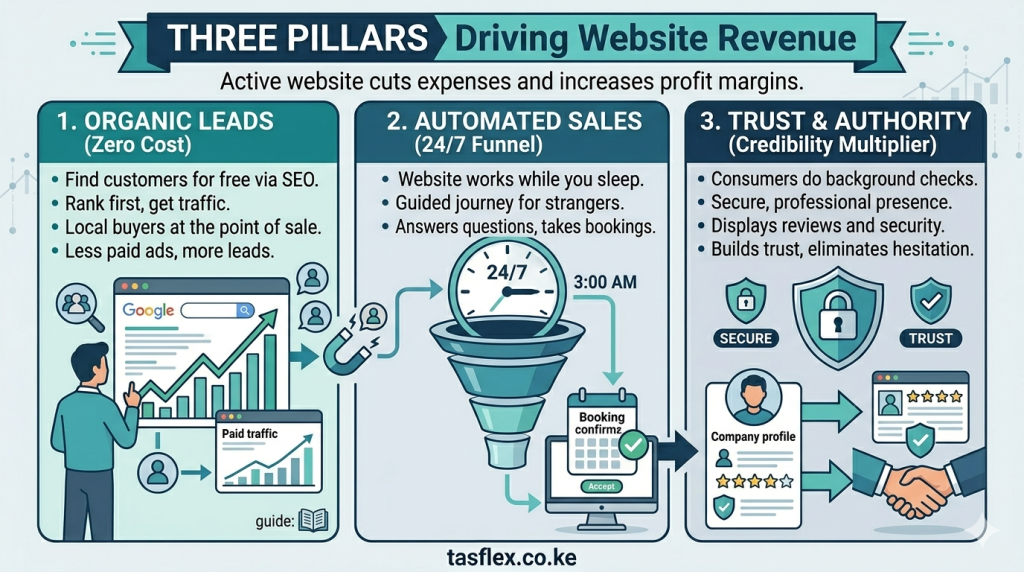
A high-performing website doesn’t just sit there looking pretty; it actively cuts down your business expenses and drives up your profit margins through three primary avenues.
1. Zero-Cost Customer Acquisition (Organic Traffic)
If you rely entirely on paid advertisements (like Google Ads or Meta Ads), your customer pipeline stops the exact second you stop pumping money into the ad platforms. A website optimized for search engines brings you customers organically, meaning for free.
When your site ranks on the first page of search results, local buyers find you right at the exact moment they are looking to buy. This inbound traffic machine is exactly how SEO helps businesses get more traffic, leads, and sales without draining an advertising budget.
2. The 24/7 Automated Sales Funnel
Your human sales team has to sleep, take weekends off, and handle administrative paperwork. Your website never sleeps. A properly designed digital asset acts as an automated sales funnel that welcomes a stranger, explains your core value, answers their major questions, and collects their booking information—even at 3:00 AM.
To see how this process looks structurally, look at our comprehensive guide on what is a sales funnel and how to build one for your business.
3. The Trust and Authority Multiplier
In the modern economy, consumers are incredibly skeptical. Before a customer hands over their hard-earned money, they will perform a quick background search on your company. If you do not have a secure, professional website, you instantly lose credibility.
A premium online presence automatically builds trust, displays customer reviews, and handles security validations smoothly, eliminating client hesitation. If your current site isn’t closing deals, dive into our structural diagnosis on why your website fails to build trust and authority.
Poorly Optimized vs. High-Converting: The ROI Reality
To illustrate the financial impact of professional digital design, let’s compare two different business paths over a one-year period. Both businesses get exactly 10,000 visitors to their website per year, selling a product or service worth $100 (or KSh 13,000).
| Performance Metric | Business A (Cheap, Slow Website) | Business B (Optimized, Turnkey Website) |
| Annual Web Visitors | 10,000 users | 10,000 users |
| Average Page Load Speed | 6.5 Seconds (Very Slow) | 1.8 Seconds (Blazing Fast) |
| Conversion Rate (Form Sign-ups) | 0.5% (Only 50 buyers) | 3.5% (350 buyers) |
| Total Annual Revenue Generated | $5,000 (KSh 650,000) | $35,000 (KSh 4,550,000) |
| The Verdict | Barely covered initial cheap build costs. | Massive positive ROI that scales year over year. |
The difference between these two scenarios isn’t the amount of traffic; it’s the technical execution. Business B utilized professional landing layouts, edge caching, and mobile optimizations to turn casual traffic into actual income. Learn the structural secrets behind Business B’s success in our master guide to the secret behind high-converting websites.
Balancing the Equation: Initial Costs vs. Long-Term Returns
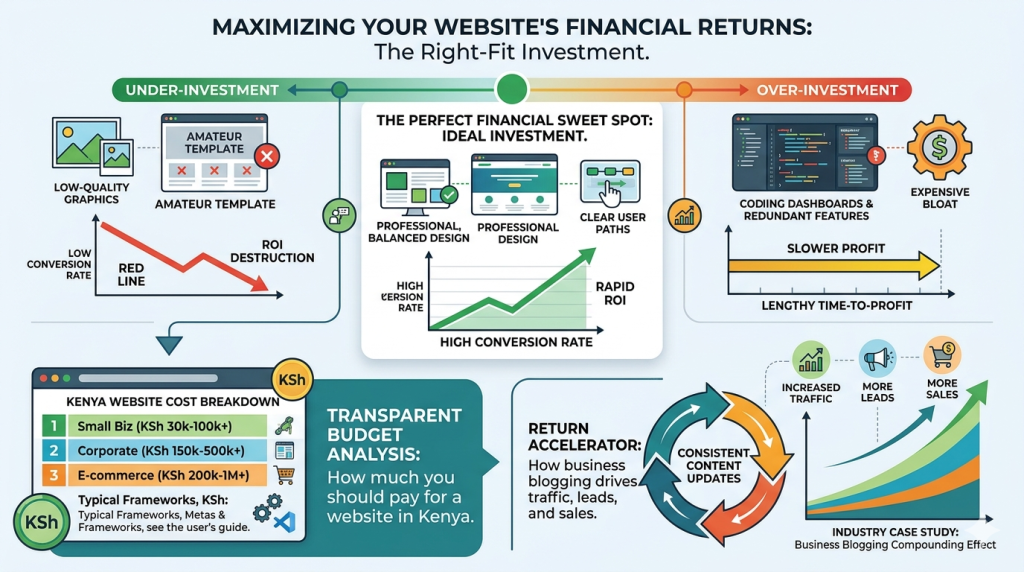
To accurately understand your website’s financial returns, you must align your expectations with realistic development pricing. If you pay too little for an amateur template, your conversion rates drop, destroying your returns. If you overpay for complex coding features your small business doesn’t actually need, your time-to-profit takes too long.
Finding that perfect financial sweet spot is key to a rapid investment return. For a completely transparent breakdown of standard market prices and development frameworks, review our budget analysis on how much you should pay for a website in Kenya.
Once your infrastructure is live, you can steadily accelerate your returns by deploying consistent content updates. This organic compounding effect is explored deeply in our industry case study on how business blogging drives traffic, leads, and sales.
Frequently Asked Questions (FAQs)
How long does it take for a new business website to show a positive ROI?
For most small-to-medium businesses utilizing proactive client acquisition and search engine optimization, a professional website typically achieves a positive financial return within 3 to 6 months of launching.
Can I get a good ROI from a free social media page instead?
Social media pages are great for top-of-funnel awareness, but they suffer from low conversion rates because you do not control the user environment or the algorithm. A website gives you complete control over the layout, payment processing, tracking pixels, and customer data, yielding a far higher long-term financial return.
What is the biggest killer of website ROI?
Slow loading speeds and poor mobile layouts. If your website takes more than 3 seconds to load on local mobile connections, more than half of your potential customers will hit the back button before ever seeing your logo, wasting your traffic and acquisition efforts.
Engineer High-Performance Profit Centers with Tasflex
A business website is not an operational expense, it is a powerful investment engine. When built with a clear focus on user psychology, lightning-fast execution, and search engine visibility, your website becomes an asset that continuously generates cash flow, lowers your customer acquisition costs, and builds long-term equity for your enterprise.
Stop treating your digital real estate like an afterthought. Let’s build a fast, secure, and authoritative system designed specifically to scale your revenue. Explore our high-performance Tasflex web design, development, and advanced conversion services, and let’s position your business for massive financial growth.