


Table of Contents
Nairobi is a city that never hits the brakes. From the chaotic but highly profitable wholesale streets of the Nairobi CBD to the shiny corporate towers of Upper Hill and the creative tech agencies in Westlands, everyone is trying to build a brand and scale their biashara.
As we cross into 2026, almost every small and medium enterprise (SME) in Kenya knows they need an online presence. Millions of shillings are spent every year building digital storefronts. However, if you look closely at the internet space right now, a painful truth emerges: the vast majority of local business platforms are completely ghost towns. They sit on the web without bringing in a single new phone call, lead, or M-Pesa transaction.
Why does this happen? It is usually not a lack of effort. Instead, it comes down to a set of preventable, critical website mistakes Nairobi businesses make during the design process. If your online office is hard to find, slow to load, or confusing to use, your potential clients will click away within three seconds.
This long-form, simple-language guide will look directly into the most destructive business website mistakes, explain why business websites fail in Kenya, and show you exactly how to improve business websites in Nairobi so you can turn casual online traffic into consistent revenue.
Why Most Nairobi Business Websites Fail

Building a digital storefront is easy, but building one that actually makes money is a completely different story. Many local entrepreneurs think that a website is just a digital business card. They pay someone to design a nice-looking homepage, put up their logo, write a basic “About Us” paragraph, and then wait for the phone to ring.
This passive mindset is exactly why business websites fail in Kenya. A successful online asset must work like an active, aggressive real-world salesman. It needs to look clean, attract high-intent local traffic from Google searches, answer immediately what problem you solve, and make it incredibly simple for a customer to make a purchase or ask for a quote.
Traditional Mindset:   Build a site -> Leave it alone -> Expect automatic sales (Fails)
Modern Growth Mindset: Optimize speed -> Target local keywords -> Guide the user to checkout (Succeeds)
When a platform ignores the daily habits, network limitations, and buying behavior of the local Kenyan market, it turns into a bad business website. Let us break down the specific technical and layout errors that are silently killing your conversion rates.
Slow Website Speed and Poor Performance
We have all experienced it: you click a link from a WhatsApp message or a Facebook ad, and the page just hangs there, completely blank, loading endlessly. What do you do? You hit the back button out of frustration and click on a competitor’s link instead.
Squeezing Your Advertisement Budgets with Heavy Loading Times
Slow website problems are the number one killer of online conversions in Kenya. Nairobians are busy, and more importantly, internet data bundles cost money. If your site is bloated with huge, uncompressed raw images, auto-playing background videos, or bad server setups, it will consume your visitors’ data allocations while making them wait.
If you are running paid advertisements on Instagram, TikTok, or Google Ads, a slow site is actively draining your bank account. You pay for the click the moment the user selects your ad. If they bounce away before your page even displays your phone number or services, you have thrown that advertising cash completely down the drain.
How to Fix Poor Infrastructure Asset Deliveries
Fixing speed issues requires clean coding and optimized server delivery methods. Your images must be compressed into modern, lightweight web formats (like WebP) before being uploaded.
Additionally, using an advanced, free Content Delivery Network (CDN) like Cloudflare can help safeguard your platform’s delivery speed and protect your business from malicious web scrapers. To learn how to implement this layer yourself, read our complete guide on how to use Cloudflare on your website.
Bad Mobile Design Mistakes
One of the most catastrophic web design mistakes Kenya has running rampant right now is designing websites solely for wide desktop screens. An entrepreneur sits in an office block in Kilimani, looks at their new website layout on a wide 15-inch laptop display, and happily gives the developer the green light.
Failing the Mobile-First Reality of Kenyan Internet Users

Here is the problem: over 85% of your target market in Nairobi uses a smartphone to browse the internet. They are checking out your services while riding in a matatu on Thika Road, stuck in traffic on Mombasa Road, or taking a quick lunch break at a cafe in the CBD.
┌─────────────────────────────────────────┐
│        DESKTOP VS MOBILE VIEWS          │
├─────────────────────────────────────────┤
│  [Desktop View]  --> Large text, multi- │
│                      column layouts.    │
│                                         │
│  [Mobile View]   --> Stacks into a clean│
│                      single column.     │
└─────────────────────────────────────────┘
A poor website design treats mobile users as an afterthought. Common mobile layout mistakes include:
- Text that is so microscopic users have to pinch and zoom their screens to read your contact page.
- Links and navigation buttons that are squeezed too close together, making it impossible to click the correct option with a normal human thumb.
- Giant pop-ups or sidebar widgets that cover the entire mobile screen and hide the main exit button.
If your platform does not feature a flawless, responsive mobile-friendly website wireframe, it will create severe website user experience issues, forcing your prospective customers to leave. For a deeper look at the connection between layout quality and sales performance, view our study on how website design affects customer trust and sales.
Weak Calls-to-Action That Kill Conversions

A Call-to-Action (CTA) is an explicit instruction that tells your online visitors exactly what move to make next. Examples include buttons like [Call Us Today], [Book Your Consultation], or [Buy Now via M-Pesa].
Why Your Website Is Not Converting Visitors Into Warm Leads
One of the most frequent website mistakes that lose customers is leaving visitors completely stranded on a page. A user lands on your site, reads through your long text about your corporate values and history, reaches the bottom of the page, and finds… absolutely nothing. No button, no phone number, and no contact form.
Kenyan buyers prefer immediate response paths. If your site makes them scroll all the way back up to the header menu just to look for your phone number, many will simply give up. This lack of direction leads to severe website conversion issues, where high web traffic results in zero actual sales or phone inquiries.
Broken User Flow: User lands -> Reads content -> Reaches bottom -> No button -> Exits (Sale Lost)
Optimized User Flow: User lands -> Reads content -> Finds Bold WhatsApp CTA -> Clicks & Chats (Sale Won)
The Power of Frictionless, Automated Contact Setup
To maximize your business website optimization metrics, place clear, highly visible CTA buttons at regular intervals on every landing page.
For the local Nairobi market, having a floating “Chat on WhatsApp” button or an instant automated M-Pesa STK Push checkout eliminates buying friction and makes it incredibly easy for users to transact. If you are launching a startup or looking to adjust your sales funnels, look through our analysis of the top website mistakes small businesses in Kenya make.
Poor SEO and Google Visibility
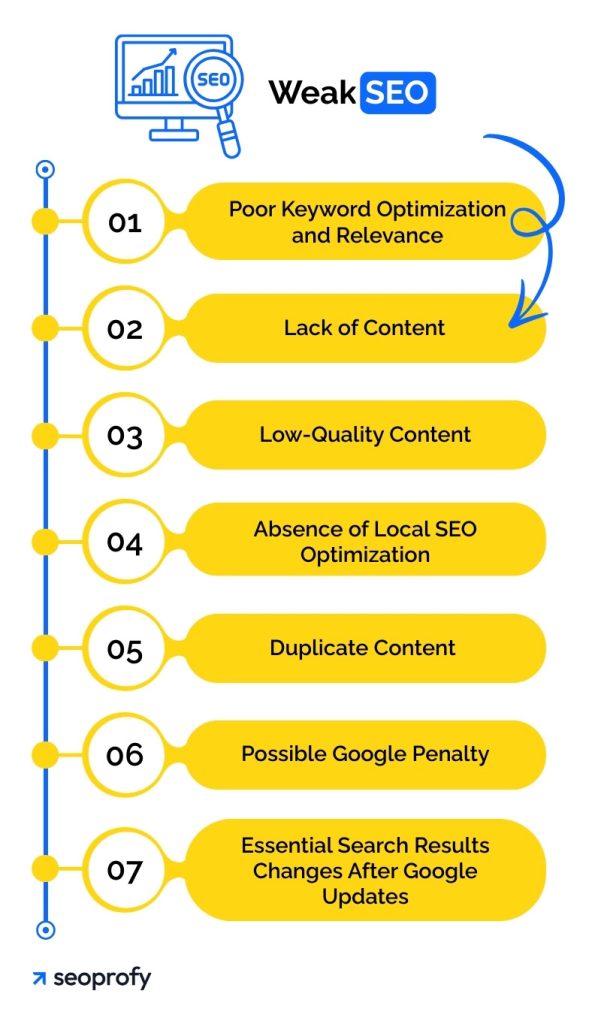
Building a beautiful platform but ignoring Search Engine Optimization (SEO) is the financial equivalent of printing a thousand premium business cards and hiding them inside a locked drawer in your house. Nobody knows they exist, and they bring zero value to your daily operations.
Critical Mistakes That Hurt Website SEO Metrics
Many web developers in Kenya can design attractive layouts, but very few understand how to structure a site so that search engines can actually crawl, index, and understand it. This disconnect leads to severe SEO mistakes that completely destroy your online visibility Kenya rankings.
| Common SEO Blunder | Why It Hurts Your Nairobi Business |
| Missing H1, H2 Headings | Google cannot identify what your services are or where you operate. |
| No Local Geographic Target | You try to rank for generic global terms instead of local Nairobi searches. |
| Thin, Plagiarized Copy | Copying text from foreign websites causes search engines to penalize your site. |
| No XML Sitemap Configured | Search engines take weeks or months to notice when you add new pages. |
If someone goes to Google and types “best delivery company in Industrial Area” or “private dental clinic in Westlands”, and your site is buried on page 5 of the search results, your business is effectively invisible. You are handing high-intent, ready-to-buy customers straight to your local competitors.
Securing Local Map Search Dominance
For small enterprises, the fastest way to gain organic search positioning is by combining an optimized platform with a verified local map footprint. To ensure your business shows up on search maps when local customers look for your services nearby, follow our step-by-step masterclass on how to create a Google Business Profile.
Using Cheap or Outdated Website Designs
We completely understand that running a growing small business requires strict budget management. However, trying to cut corners by hiring an unverified university student, a cheap freelancer from a random social media group, or using a completely outdated web system is a recipe for long-term financial disaster.
The True Hidden Costs of a Bad Business Website
When you pay an extremely low price for a website, you are usually buying a mass-produced, stolen template that is packed with malicious code or heavy, unnecessary elements. These cheap builds suffer from severe website problems small businesses have to deal with down the line, such as:
- Constant server crashes during high-traffic hours.
- Broken layouts that look distorted on modern smartphone updates.
- Total lack of security firewalls, making your customer database vulnerable to digital hackers.
An outdated, buggy layout immediately signals a lack of professionalism and authority, actively creating customer trust website challenges. If you want to protect your investment and learn how to plan a realistic development budget without getting overcharged or scammed, check out our guide on how much should you pay for a website in Kenya.
Why Social Media Alone Is Not Enough
A major trend among young entrepreneurs in Nairobi is trying to run a full commercial enterprise using nothing but an Instagram page, a TikTok profile, or a WhatsApp catalog. While these networks are excellent tools for building initial brand awareness, relying on them as your sole digital foundation is incredibly dangerous.
The Vulnerability of Building on Rented Digital Land

When you run your business entirely through social networks, you do not own your digital space, you are renting it. Social media algorithms change constantly, and your organic reach can drop from thousands of views to zero overnight. Worse, a single false report by a competitor or an automated system error can cause your entire account to be permanently banned, wiping out your audience instantly.
Furthermore, selling products via social media direct messages (DMs) introduces massive friction. The phrase “Inbox for prices” frustrates local consumers and screams a lack of professional transparent business practice.
A custom website acts as your secure digital anchor, moving your customers away from noisy social spaces and into a controlled, professional environment. For a deep look at where you should focus your primary brand building energy, read our comparison on website vs social media in Kenya.
How Professional Websites Increase Trust
In the Kenyan online marketplace, building unshakeable consumer trust is the single most important factor that dictates whether a sale happens or not. Because of past experiences with online scams, local buyers are highly skeptical when interacting with a new online brand for the first time.
Eliminating Buyer Doubts with Clean Web Architecture
A premium, professionally developed platform instantly bridges this trust gap. When a client sees a site that loads instantly, displays an official .co.ke custom domain name, and showcases clear operational policies, their security concerns disappear.
Skeptical Buyer View: Random Social Profile -> No Official Domain -> "Inbox for Price" -> Exits Page
Confident Buyer View: Custom .co.ke Site -> Fast Mobile Speed -> Automated M-Pesa -> Completes Purchase
Your website allows you to show off your real physical location, link your official business registration details, and present high-quality local case studies. Incorporating real reviews and verified feedback from past customers directly on your landing pages is a proven mechanism to build credibility.
How Tasflex Helps Businesses Build Better Websites
At Tasflex Tech, we don’t just build pretty web templates or sell basic hosting plans. We specialize in engineering comprehensive, high-converting digital platforms designed to eliminate common website mistakes for small businesses and drive real-world financial growth for your brand.
Engineered Specifically for the Kenyan Consumer Ecosystem
We deeply understand how Nairobians browse, search, and buy online. We build lightweight, mobile-first responsive platforms that save your users’ mobile data packages and load flawlessly across all local cellular networks. From full Lipa na M-Pesa STK Push API integrations to advanced technical local search optimization, we build your site to compete and win.
We take the technical burden entirely off your shoulders, handling cloud speed setup, firewall security protocols, and regular site maintenance, so you can focus on scaling your daily logistics and operations.
If you are tired of dealing with an unoptimized platform that is losing you clients, check out our primary Website Design Nairobi hub page to look through our latest design builds and lock in a free expert consultation today.
Frequently Asked Questions About Web Design Mistakes in Kenya
Why does my website look great on my laptop but completely broken on my phone?
This happens because your platform lacks a true responsive web design framework. Your current layout was likely built using rigid, fixed widths that look fine on wide screens but fail to scale down automatically when viewed on compact mobile screens.
At Tasflex Tech, we always practice mobile-first development, building and testing the smartphone layout first before expanding it to fit wide desktop monitors.
How can I check if my current business website is too slow for mobile data users?
You can test your live site speed using free global diagnostic tools like Google PageSpeed Insights or GTmetrix. These tools analyze your page structure, calculate your loading times on standard mobile networks, and provide a clear report of what elements are causing your slow website problems (such as massive, uncompressed images or bad server response setups).
Is it hard for me to edit text or fix minor mistakes on my website myself?
Not if your site is built using a modern Content Management System (CMS) like WordPress. When we deliver a completed web platform to our clients, we provide full, step-by-step video training.
We show you exactly how to log into your admin workspace, edit text fields, change pricing lists, or upload new blog articles using any basic smartphone or computer without touching a single line of complex code.
How can a small business in Nairobi protect its website from being hacked or spammed?
Securing your platform requires a multi-layered security strategy. You must install a valid SSL Certificate (the padlock icon next to your URL), use complex administrative passwords, keep your plugins and theme systems updated regularly, and install active web firewalls. Connecting your platform to an optimized CDN network like Cloudflare is also an excellent way to filter out malicious bots and spam traffic automatically.
What is the most important feature to fix if my website is not converting visitors into leads?
Start by clarifying your primary Call-to-Action (CTA). Ensure your phone number, a direct “Chat via WhatsApp” button, or an inquiry form is prominently displayed right at the top of your homepage and repeated at the bottom. Eliminate all confusing text clutter and make the exact path a customer needs to take to buy from you as simple and visible as possible.
What is Your Next Growth Step?
An unoptimized or outdated web layout is not just a technical problem, it is a continuous financial leak that is quietly driving your ideal customers straight to your local competitors. It is time to transform your platform into a high-performance sales asset.
What is the single biggest technical issue or layout problem you are currently noticing on your business website? Let us troubleshoot your strategy in the comment section below!
Subscribe to Our Newsletter to Get Helpful Tips to Help Grow Your Business!